Road Trip! Buffalo, New York

Amanda Donnan | May 2nd, 2012

In late March, Dan and Tina and I drove up to Buffalo for the opening of Wish You Were Here: The Buffalo Avant-Garde in the 1970s at Albright Knox Gallery. The show was curated by former Carnegie International assistant curator Heather Pesanti, and represents the culmination of three years’ intensive research. We came into the city from the south, and passed through Buffalo’s (post)industrial waterfront on our way to our hotel. I’ve seen a few abandoned steel mills in my day, but found the scale of Buffalo’s grain elevators astounding. Wish made a similar impression later that evening: all three of us were pretty well floored by the sheer scope of the show—which includes not only visual art, performance, and film, but literature and music as well—and the extraordinary roster of artists that have called Buffalo home.

  Read the rest of this entry »

Jamie Skye Bianco, Haakon Faste, and Justseeds at Apartment Talks

Amanda Donnan | April 20th, 2012

Apartment Talk # 8: Jamie Skye Bianco and Haakon Faste

On March 13, we hosted two very engaged local academics doing interesting work at the intersection of new media, the humanities, and design. Jamie Skye Bianco is an assistant professor in the Composition, Literacy, Pedagogy, and Rhetoric group at the University of Pittsburgh, where she specializes in digital media, digital composition and rhetoric, media theory, and contemporary narrative. Jamie talked about her work in digital/tactical media and human affect, and screened some of her video work.

Haakon Faste is a visiting assistant professor in the Human-Computer Interaction Institute at CMU, where his research focuses on virtual experience and interaction design. His recent installations incorporate real-time interaction and immersive environments drawing on novel paradigms such as telepresence robotics, stereoscopic projections, and kinesthetic immersion. Haakon discussed ways in which perceptual robotic art might save the human species from extinction. Minds were blown.

More about Jamie

More about Haakon

Apartment Talk # 9: Mary Tremonte and Shaun Slifer of Justseeds Artist Cooperative

On April 11, Mary Tremonte and Shaun Slifer of the Justseeds Artist Cooperative (a decentralized group of 24 artists with a distribution center in Pittsburgh) presented the group’s portfolios, prinstallations, and interventions in support of causes like Artists Against the Prison Industrial Complex, the Occupy movement, labor rights, and fracktivism. I’ve included photos from their collaboration with Iraq War Veterans Against the War called Operation Exposure, in which Coop members teamed up with vets to poster Chicago and raise awareness about the traumatic effects of combat. Also included are a couple images of their recent Voices From Outside exhibition, organized in collaboration with Book ‘Em, a local books-to-prisoners program.

More about Justseeds, including protest poster downloads and prints for sale.

Rammellzee

Daniel Baumann | April 11th, 2012

Back in 1982, over in Switzerland, we got into rap and were constantly searching for new releases. One of the important series was Street Sounds Electro 1–22, with the outstanding no. 2 that included “Beat Bop” by Rammellzee versus K-Rob. Rap was part-party, part-pushy (and who remembers the short-lived Washington Go Go?), but “Beat Bop” wasn’t. It was a slow and lazy 10-minute piece (listen) and we loved it for this. In the mid-1980s, I visited Rome with my father and we happened to walk by Piazza di Spagna where we suddenly saw a big crowd. It was a public fashion show by Valentino and all flashes were directed on the Italian actor Gina Lollobrigida. But the really important thing (at least to me) followed once the show started: Rammellzee came on stage and did the live music. Later on I found out that Basquiat had done the sleeve for the 45 rpm release (see images below). And only many years later, when researching Rammellzee on the net I found his site, Gothic Futurism, with a mind-boggling text on “Ikonoklast Letters Racerism” and the Letter Racers. I always wanted to see them and finally did, last week, at The Suzanne Geiss Company (until April 21). The show is great, although suffering from Rammellzee’s absence (he died in 2010), but it included an amazing drawing from 1979 (see a detail above). And MoMA (I can’t believe that they did) included his work in Print/Out (until May 14). So Christophe, are you going to add Rammellzee’s work to MoMA’s collection? Can you go that far?

Who is Hisachika Takahashi?

Daniel Baumann | April 3rd, 2012

I need your help. I ran through the catalog Aspects de l’art actuel, Paris Festival d’Automne (1973) and saw this spread by Hisachika Takahashi (b. 1940). Not much information about him online. He worked with Lucio Fontana on a really great Concetto Spaziale painting in 1966, he collaborated with Robert Rauschenberg for a show in Israel and was his assistant, and he is mentioned within the context of New York’s alternative art space 112 Workshop and was in a group show at White Columns in 1972. The most complete entry I found is this. Takahashi seemed to have cooked at Gordon Matta-Clark’s Food restaurant in the 1970s, so is the artist the same as the chef? Do you know more? Thanks!

DEAR ALL, MANY THANKS FOR YOUR HELP!

I just found these few pages out of a catalog that I wanted to share. And thanks to Jeff from White Columns for this link, check it out!

Braddock’s Neighborhood Print Shop

Amanda Donnan | March 22nd, 2012

Last Friday I drove out to Braddock for the Neighborhood Print Shop‘s party for departing artist-in-residence, Jim Kidd. The product of Kidd’s residency, a lovely handmade book filled with “Kiddisms” drawn from a series of journals the artist has kept since 1967, was on sale for $25 to $60, depending on what each buyer could spare.  The event was also a welcome reception for the next resident artist, LaToya Ruby Frazier, a Braddock native whose annotated photographs chronicling UPMC’s withdrawal from Braddock and Levi’s aestheticization of the city’s blight are currently featured in the Whitney Biennial.  After spending the latter half of the previous week in New York at art fairs, this get-together in the Braddock Carnegie Library felt refreshingly intimate and inclusive, despite Frazier’s art world notoriety.

Read the rest of this entry »

Film Posters 1976–1981

Amanda Donnan | March 16th, 2012

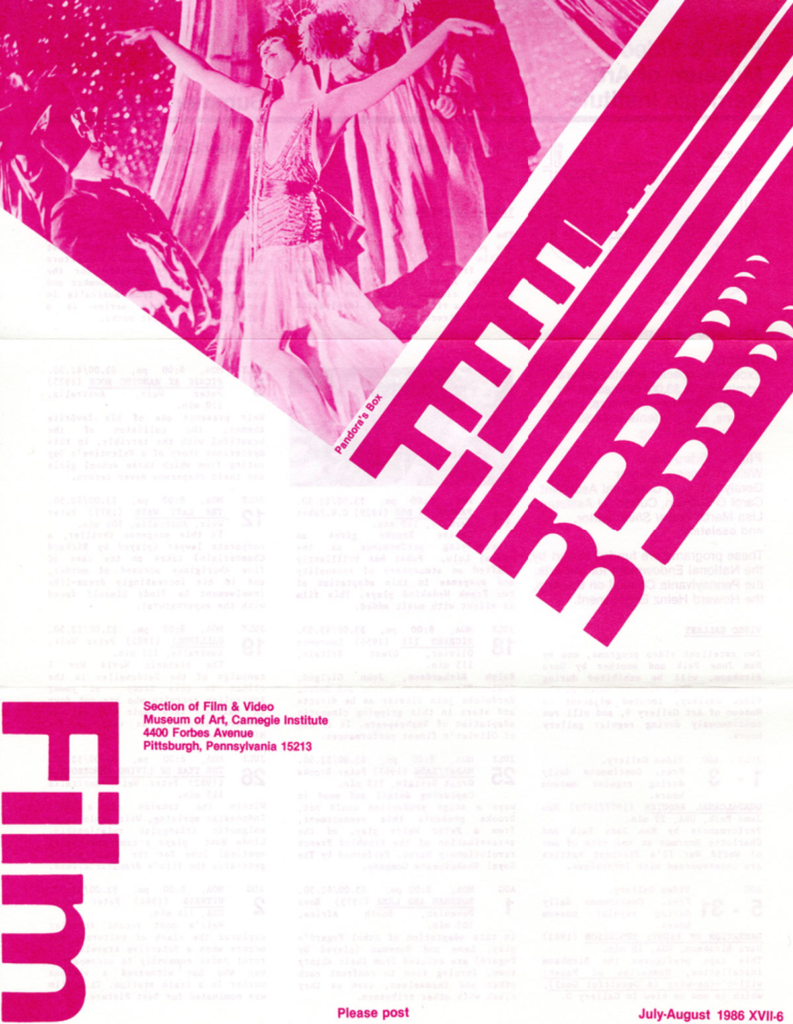
Between recent exhibitions like Paul Sharits at Greene Naftali and upcoming shows like Wish You Were Here: The Buffalo Avant-Garde in the 1970s at Albright-Knox, experimental filmmakers who came to prominence in the 70s are getting their due these days. We’ve been taking stock of our film collection, too, with help from an A.W. Mellon Foundation grant, so it seemed like an opportune moment to share a selection of posters from an amazing series of artist talks and screenings hosted by the Carnegie Film Section (1970–1980), later the Department of Film and Video (1980–2003). Some of the rarest and most valuable material in our collection are recordings from these presentations.

Read the rest of this entry »

Bruce Hainley on the early performance work of Sturtevant

Daniel Baumann | March 13th, 2012


Get $10 (U.S.) and run to the next bookstore, Kiosk or Koenig to get Artforum‘s March 2012 issue. Open it to page 226, and read Bruce Hainley on Sturtevant. Since being exposed to Seth Price’s texts on production technologies (in my opinion, the objects he produces are “just” (great and disturbing) footnotes to these texts), I haven’t had such an addicting, inspiring, and disturbing reading experience. Following Hainley’s words, you are able to experience what this means: “The dynamics of the work is that it throws out representation” (Sturtevant, 2004). It becomes almost tangible that her practice of “mise en abyme” indeed makes thought visible.

And then you stumble into paragraphs like this: “Even without knowing, definitively, what Sturtevant danced, consider why she might have rendez-voused with Rainer at all, since Sturtevant was always already dancing, as Nietzsche said everyone must—always already thinking not across the art of the 1960s but into the structures that make such art, such thinking possible. She was manifesting instead of writing manifestos.”

Oh yes, and where else, in what kind of other text on art you can read something like this:
“And then there was Jill Johnston.
Jill fucking Johnston.
On the beat, doing her job, brilliantly, tweakily.”

To which I can only add: “And then there was Bruce Hainley. Bruce fucking Hainley. On the beat, doing his job, brilliantly, tweakily.”

Filmoteka Launched out of Warsaw

Tina Kukielski | March 9th, 2012

Wow, this is really something special. Just a few days ago, the Museum of Modern Art Warsaw launched an online collection of Polish film and video: Filmoteka. It’s all there— digitized, catalogued by artist, and accessible by the click of a button. (Thanks to Tate film curator Stuart Comer for pointing this out in his talk at Carnegie Mellon’s School of Art last night.) You will remember names like Paweł Althamer, Katarzyna Kozyra, Wilhelm Sasnal, and Mirosław Bałka from past Carnegie Internationals. But check out the long list of films by Artur Żmijewski and Zbigniew Libera as well as Yael Bartana, Joanna Malinowska, Wojciech Bąkowski, and Anna Molska. The Lawrenceville Apartment needs to host a night of screenings, stat!

Fun in an exhibition (and letting interactive art get the best of us)

Dan Byers | March 5th, 2012

I’m going through old travel photos, and these two bring back memories. On our first trip together with all three curators, to Frieze Art Fair in 2010, Tina and I went to the Hayward Gallery to see Move: Choreographing You. We got a bit tangled in the art. The exhibition was actually a lot of fun, and distinguished itself from the rash of recent interactive/audience-centered exhibitions by focusing on the idea of choreography, both explicitly and through sculptural installations.


Tokyo

Dan Byers | March 1st, 2012


I just got back from a great two-week trip to Japan, sponsored by the Japan Foundation. Along with eleven other contemporary art curators working in the US, we traveled to Tokyo, Kanazawa, Kyoto, Osaka, Naoshima, Takamatsu, and then back to Tokyo. After an all-too-brief trip to Yokohama this past October, I felt very lucky to have two weeks in Japan. Read more “after the jump,” as they say… Read the rest of this entry »

Hans Haacke at the Reina Sofia

Tina Kukielski | February 29th, 2012

Madrid is a late-night city. You’ve probably heard that the Spanish are notorious for eating late, but you might not know that the museums are open late too. During a short trip to Madrid for the ARCO art fair, I found myself at the Museo Nacional Centro de Arte Reina Sofia until 9 p.m. most nights, waiting for dinner to start and trying to keep my feet steady walking through the museum’s endless rooms. The first night, jet-lagged but art-hungry, I attended the opening of an exhibition of the work of Hans Haacke, the German-born American artist known primarily for his institutional critiques bordering on investigative journalism. If you wade through Hans Haacke’s long exhibition history, you find a shortlist of the most important art exhibitions of the last 45 years: Earth Art (1969); Live in Your Head: When Attitudes Become Form (1969); Documenta 5 (1972); Magiciens de la terre (1989); Image World: Art and Media Culture (1989); Documenta X (1997); and Beyond Geometry: Experiments in Form 1940s–1970s (2004), not to mention the Venice Biennales. I realized that outside of gallery presentations, I had never seen a major show of Haacke’s in the U.S., and that’s because there hasn’t been one. Recognizing my good fortune, I switched shoes, forgot about dinner, and dug in.

Corin Hewitt at Apartment Talks

Tina Kukielski | February 21st, 2012


Apartment Talk #7 Corin Hewitt

One of my favorite past curatorial projects was Corin Hewitt’s Seed Stage. As a curator, you move on quickly at the end of projects, on to the next set of problems to be solved. Corin moved to Richmond to teach sculpture to grads at the Virginia Commonwealth University at about the same time I moved to Pittsburgh, but we kept in touch. It was fortuitous that Corin was on his way to town to meet some cool robotics folks at the CREATE Lab at Carnegie Mellon. He flew in a bit early to talk to us about his sculptural practice, his ongoing performative projects, and the burden and blessing of family influence.

Oh Pittsburgh!

Daniel Baumann | February 15th, 2012

 
The other day, I got an invitation for a party sent by videographer Ben Hernstrom. I couldn’t make it, I had already left Pittsburgh for Basel, but at the end of Ben’s email I found the link to www.ambulantic.com. It took me to a series of Ben’s films and I spent the rest of the evening lingering from one thing to the other. Well, you know Pittsburgh…. first you think, okay, not uninteresting, its history, bridges, Steelers, and Warhol. But the more I go there, the better I like it. No boutique destination, great bars (more about this later), it’s a real city with real people. What does the Washington Post say? “Pittsburgh, Pa., is cool now.” Well, then.

But back to Ben’s films. The first one made me discover Western Pennsylvania’s most complete hobby shop including the slotcar test drive. Not everybody is a hobbyist though. The film that really made me stay was The Hope Business (by Dana Goren, shot and edited by Ben Hernstrom), a portrait of Bill Strickland of the Manchester Craftsmen’s Guild. You may know him, I didn’t. So I watched this film and at the certain point, he says these incredible things: “No one assumed that the arts would have anything to contribute to making life better in the community,” and “I knew that or had sensed that if you could create a beautiful space it would ultimately create beautiful people.”

Yes! But I could never say this. Or rather, some years back, I would have said: “Oh how common, the same old idealistic dreams over and over.” But then, as many others do too, I got tired of the money-monkey-years (as we try to get out of them). And Strickland’s comments are not theories, but experiences, and I trust them more. Anyway, this is Pittsburgh: you find yourself in a city where intense history, amazing engagement, and a great dose of ambivalence is no fancy pose, but just around the corner. Just like these great bars: Gooski’s (no homepage, but Oh that jukebox!) and Cattivo (love that homepage).

Richard’s Bar, Pittsburgh. The Housewarming Performance feat. Yamasuki

Daniel Baumann | February 8th, 2012

On Friday February 3, 2012, we met at 9 p.m. to celebrate the opening of Richard’s Bar at 4400 Forbes Avenue, Pittsburgh, PA. We entered the freezing and badly lighted bar where Swiss artist Tobias Madison taught us the five movements as listed on the backside of the LP Le Monde Fabuleux Des Yamasuki (coll. John Paul MacDuffie Woodburn), an album described by Discdogs as follows: “The 1971 concept album was the brainchild of French pop composers Jean Kluger and Daniel Vangarde, who learnt Japanese before recording began and even enlisted the aid of a renowned black-belt Judo master to introduce the tracks, which were all sung in Japanese by a school choir. The result is theatrical, epic, freaky and exotic pseudo-Japanese pop that absolutely defies categorization.”

The performance that followed defied categorization as well. Due to lack of space, we had to go outside onto the bar’s vast terrace. There, we followed the movements / indications for a five-part performance as printed on the back of the LP Le Monde Fabuleux Des Yamasuki. Written in French, we translated it into English thanks to an Internet translator (which added some unexpected words and sense to the instructions, producing even more “de-categorization”):

the YAMASUKI is a sequence of attitudes and gestures that express the $ ·
of. Ia life. Is changed. position to each sound.

major themes

THE SALVATION:
clasped hands, ((n in prayer, we look forward slowly year
(photo 1), one recovers, we turn to his right
then left 0 (Jand I are Chmura, begin to sing, it starts
not place a sill). ilar to that Ia ~ e samba. (phot ~ 2)

JOY ·:
· and legs spread arms are swinging it right and turn
gauehe emphasizing one of mouvenlent. appears on the legs.
(photo 3)

FEAR:
Rapla arms around the face. (photo 4)

GRACE:
arms perform graceful movements of oriental style.
COM THE BAT:
Preparati9n: legs apart, hands on thighs, jump
there.

Attack: Taking the positions of karate (photo 5) shouting
“C • aa ooh n.

Hara Kiri: you push the cry of the Kwai •
.
We start with THE SALVATION. JOY. and so on.

Richard’s Bar will open again, we will let you know!

Dakar, Sénégal. Condition Report: Symposium on building art institutions in Africa

Daniel Baumann | January 31st, 2012

One of the reasons I went to Dakar was to follow the “Symposium on building art institutions in Africa”, organized by Koyo Kouoh, the founder of Raw Material Company. Established in Dakar since 2008, Raw Material Company is “a center for art, knowledge and society.” With the self-confident claim that “The art scene in Africa is growing mainly on impetus of independent initiatives,” the symposium brought together some of Africa’s most important independent art spaces and initiatives as well as a series of exemplary projects from other continents. I learned a great deal about how the colonial past continues to provoke questions and polemics (while countries like China are buying up Africa’s agricultural land). It also became clear that a young generation of African curators, intellectuals, and artists are willing to change things and to build up meaningful projects while the ruling class and the politicians in power are envious, passive, or are attached to old concepts and privileges. Within the range of initiatives, I felt particularly drawn to artist-run projects like:

Maxo Vanka Murals

Tina Kukielski | January 31st, 2012

When you look out past the railroad tracks across the Allegheny River (just down the block from the artist’s apartment in the Pittsburgh neighborhood of Lawrenceville) you see Millvale, Pennsylvania. One Saturday this fall I ventured over to this small hamlet of a town, wandering past worn industrial buildings, a few newly-sprouted community gardens, rowhouses—likely the homes of former steel workers—and old churches. On the walk I met a young man from town on his way to one such church: St. Nicholas Croatian Catholic Parish. He was about to give a tour of the church’s murals and asked if I wanted to come along. I had heard about an artist of the WPA era whose murals had recently been preserved, but hadn’t realized they were in the neighborhood. The church was cold and dark upon entry. A few others gathered in the lobby for the tour. Over the next hour-and-a-half I relaxed into a pew, craning my neck upward in delight as the young man and his fellow tour guide, a retired history teacher, talked to us about the Croatian American artist I had heard of only in passing: Maxo Vanka.

For some time in 1937 and then again in 1941, after Vanka naturalized as a U.S. citizen, the artist painted over 22 murals in tempera on site in St. Nicholas, a congregation home to ten percent of the U.S. Croatian immigrant population at the time. Themes of war and the rising labor movement dominate Vanka’s powerful scenes. The dress and ceremony of mourning women, I was told, was an Old World Croatian tradition. The faces of Vanka’s women had a sobering Byzantine look and feel to them with wide eyes full of sadness. Two of the most memorable murals for me include Injustice, depicted as a frightening woman wearing a long black gown and gas mask, holding scales unequaled by greed, a bloody sword resting on her shoulder. Another was The Capitalist, a Mr. Burns-style industrialist in top hat smoking a long cigarette, almost chucking to himself while reading the stock report as he is served a gluttonous feast.

Interestingly, Vanka was not religious. His accomplishment in Millvale speaks to an era of hard labor and sorrow that today we appreciate not as religious fervor, but rather, simple human history. For the curious, plan a visit on the weekend and call ahead for tour times, or get your hands on filmmaker Kenneth Love’s recently premiered documentary: Maxo Vanka’s Masterpiece: The Murals at St. Nicholas Church.

Cathy Wilkes

Dan Byers | January 23rd, 2012

I was introduced to Cathy Wilkes’s work by Yasmil Raymond when I was working at the Walker Art Center. Wilkes was a linchpin of Raymond’s exhibition Abstract Resistance. She and I talked about the show at length, and while I was always compelled by the images of Cathy’s work, something seemed to be missing for me. …Turned out that the missing element was actually seeing the work in person. (Imagine!) Her installation in Abstract Resistance was raw, visceral, delicate, psychologically complex, and beautiful in a way that was quiet, peaceful, and dark. The Sunday following the opening, Cathy gave a talk at Midway Contemporary Art. It remains the most moving, most interesting artist talk I’ve ever heard. Hearing Cathy talk about her work is as affecting as seeing it.

When Lynn Zelevansky and I took a trip to London in the spring of 2010, I went up to Glasgow by train (a BEAUTIFUL train ride) to meet with Cathy. It was a great studio visit, which gave me a lot of insight… most memorable was the altered bathtub that Cathy had up on cinderblocks that she uses to scrub the surfaces of her paintings… the paint and cleaning liquids empty through the drain into a bucket, full of dark and mysterious residue. When Cathy came to Pittsburgh after a trip to Aspen a few months later, in the middle of the winter, we looked at the Forum gallery together, deciding on a mix of recent paintings and a new installation. Most of the work she made for the show which opened here in November was actually made right in the gallery. I watched as steel frames turned into ghostly men, and saw Cathy and her assistant Darren apply what looked like hundreds of layers of papier-mâché to get the figures’ skin densities and colors just right. We had to have an attendant in the gallery after hours and on weekends as they worked. I volunteered, and am so happy I did, because I saw the work come into being, and take on meaning and force in real time, in front of my eyes.

Check out the booklet we published for the show, and read my essay, along with Cathy Wilkes’s artist statement.

Robert Breer’s Lesser-known “Floats”

Amanda Donnan | January 18th, 2012

It occurs to me that most of my posts thus far have related to something or other that has been unearthed in the process of digging around in old files. Either I love archives or just intersect with them a lot in the course of my working life… In any case, it figures that when I read Art Forum‘s recent “Passages” piece on artist-filmmaker (and 2004 Carnegie International artist), Robert Breer, who died last summer, I immediately thought of something I found in the Film Section file cabinets a while back. So here’s a tribute to Breer, nerdy archival style…

Most people talk about the domed kinetic sculptures (slow moving, self-propelled objects that the artist called “floats”) that Breer built for the Pepsi Cola Pavilion at Expo ’70 in Osaka, Japan.  And rightly so: the Pavilion was a crowning achievement for Experiments in Art and Technology (E.A.T.). People who lived in Pittsburgh during the mid-1970s, however, might best remember Breer for the three floats he made for the 1974 Three Rivers Arts Festival– a mechanized crumpled plastic mass, pyramid, and stacked box “ziggurat” that crept slowly around a plaza near Gateway Center. So slowly in fact, that their movement was nearly imperceptible, until the viewer turned around to find the arrangement had changed.

I grew up in Pittsburgh but hadn’t been born yet, so it was (exciting!) news to me when I discovered the documentation in the artist’s Film Section file. There was apparently a concurrent gallery exhibition of some of Breer’s smaller kinetic works, but I haven’t been able to find out where that took place. Some photos to share anyway, pending more research.

Please comment if you know something more about this project, or if you know who the photographer was…

Dakar, Sénégal

Daniel Baumann | January 16th, 2012

I arrived at Dakar airport around 2 a.m. on Monday, January 9, and was welcomed by hundreds of taxi drivers ready to drive me to town. Although I knew how much I should pay (or shouldn’t pay), I was very glad to see Antoine holding up my name and bringing me to Magic Land, the amusement park where my hotel was, situated just next door to the Supreme Court of Senegal. All this was a perfect start to immersing myself into Dakar. Next to Magic Land was a small bay where, at night, informal BBQs offered fish and salad. The following day, on that same beach, I discovered and visited local artist Cissé’s house and sculpture park made out of garbage. His built environment may be the world of an outcast, but it includes poetry and a good dose of contempt towards the empty discourses of officials and politicians. Cissé had realized his public art without being asked, and to me it looked more appealing than the other sculptures lined up at the seaside… (well, there was some surreal quality there too—see below).

Beirut and the Arab Image Foundation

Tina Kukielski | January 12th, 2012


In March 2011, I traveled with a colleague of mine from SFMOMA to Beirut and then onto Sharjah in the United Arab Emirates. This was during what we now know as the Arab Spring and it was my first trip to the Middle East. I tried to calm my nerves as I was picked up at the airport by George Awde, a Lebanese-American photographer and friend living and teaching in Beirut. I immediately fell in love with Beirut. It reminded me of New York in its frenetic energy and I quickly found that with that came scrumptious meals and a close-knit community of artists that reminded me of my former city. It was chaotic, decrepit, and maddening at times, but I quickly found myself feeding off of that energy. Power outages 3 hours per day were common. Lebanon, I was told, was known for the slowest internet in the world, yet Beirut was teaming with coffee shops crowded with young people borrowing free Wi-Fi. With real estate spiking on the one hand (rent is not cheap), and still bombed-out shells of buildings riddled with bullet holes on the other, Beirut revealed itself as a place of contradiction.

The artists I met were well-informed, and they all seemed to be in dialogue with one another.  A few had regular opportunities to exhibit their work in parts of Europe and the Middle East. I realized how little of their work I had seen in the US, however. The recent stories of war in Lebanon often creeped  into conversation, and with the Arab Spring erupting in neighboring regions, there was a palatable sense of unease. Beirutis describe this as the waiting, waiting for the other shoe to fall. It’s at the foundation of a lot of work I saw. Other themes being: those who “disappeared” due to crimes of war, issues of nationhood and the rebuilding of Beirut, the war with Israel, and the Palestinian refugee situation (there are over 200,000 Palestinians living in Lebanon and most cannot become citizens). An artist described the Middle Eastern situation to me as a triangle: you push against one thing and two other things arise.

ARAB IMAGE FOUNDATION
One of my most memorable visits in Beirut was to the Arab Image Foundation, a non-profit founded in 1997 dedicated to the collection and study of photographs from the Middle East, North Africa, and the Arab diaspora. Started by a group of artists including Walid Ra’ad and Akram Zaatari, the AIF (or FAI) assembles around a group of photographic archives by mostly unknown studio photographers from Lebanon, Jordan, Palestine, Syria, Egypt, Morocco, etc. We snooped around their cold storage with a guide, and roamed their database. The collection housed vernacular photography mostly, portraiture meant as keepsakes for individuals and their families at a time when cameras were not so widespread. I ogled over the strikingly beautiful (mostly) black-and-white pictures that were like nothing I had seen before.

Music and Design from Beirut and beyond

Tina Kukielski | January 11th, 2012

Over one especially memorable meal of delicious Armenian food in Beirut, I met the front men for Mashrou’ Leila, a lively 6-member indie band/orchestra that is a mix of traditional Arab music and rock. Driving home from dinner, we listened to their newly released album through the car stereo. Before I knew it, I was humming along. They play often in Beirut where they are very popular, but have never toured the US.

To see and hear more, watch this! 

ARABESQUE GRAPHIC DESIGN
Although I couldn’t translate most of the political posters and billboards littering the sides of buildings and buses, after driving around Beirut for a few hours, I quickly found that Middle Eastern graphic design is looking pretty fresh right now. My instincts proved true when I discovered that indeed it was a budding creative outlet for young artists and designers, especially amid the political fervor of the Arab Spring. Graphic identity and typography negotiates the balance of the old, calligraphic tradition, with the new—an apt metaphor for the dilemmas of the ongoing revolutions in the region.  I found this well-illustrated book (in English) featuring a number of new designers, including Persian designers as well. The editors have already released a second volume.


shorpy.com

Daniel Baumann | December 28th, 2011

Quantity and quality are the pleasures and problems of sites that collect and distribute images (like Flickr and others). Confronted with an overwhelming mass of pictures and their equally overwhelming lack of quality, you feel like sitting next to a friend who guides you through 100s of pictures of a recent trip. There are a few exceptions though, and the one I enjoy the most at the moment is shorpy.com. It offers some archaeology of every day life and provides a certain context to the pictures, which are accompanied by comments and discussions. But the real pleasure of Shorpy is that it functions like a school for composition. Most of the pictures are based on classical composition schemes; there is an air of solid formal work there and you can learn a great deal why some pictures are more efficient than others.

Out in the Margins

Daniel Baumann | December 25th, 2011

Just back from the above Walensee, Switzerland, where Swiss curator Roman Kurzmeyer opened a show by young Swiss artist Kaspar Müller (on the right, next to Pedro Wirz). It wasn’t really a show, more a necklace for an old and small haystack surrounded by snow and nature. Roman runs Atelier Amden as an ephemeral institution since 1999 and presented installations by artists such as Polly Apfelbaum, Mai-Thu Perret, Pawel Althamer, or Anya Gallaccio. Standing up there in the snow, it made me realize how much nature has vanished from contemporary art—maybe rightly so. There was a time when artists traveled to remote places, dived into foreign cultures, and exposed themselves to nature and landscape for inspiration and renewal. To escape the city became one of the trademarks of the avant-garde, from Tahiti to the American desert, from Gauguin to the artists of Land Art. It was a research that was as ambivalent as it was fruitful, but tell me about today’s artists traveling to remote places! It’s all about the city where most of the world’s population lives. Yet, there is some stuff going on in the outskirts. Although artists (and curators) don’t get any more inspired by nature and the primitive (whatever this is), they build up structures in the so-called margins: Andrea Zittel’s High Desert Text Sites, Gela Patashuri’s TCCA Museum Without Wall outside of Tbilisi, Georgia, Transformazium’s project in Braddock/Pittsburgh, or Yto Barrada’s Cinéma Rif/Cinémathèque de Tanger in Tangier, Morocco.

James Lee Byars, 1964 Carnegie International

Amanda Donnan | December 23rd, 2011

In 2010 one of our registrars, Elizabeth Tufts-Brown, turned up a treasure trove in the museum archives: a box filled with postcards and letters (performable objects?) sent by artist James Lee Byars to former Carnegie director, Gustave von Groschwitz, between 1964 and 1967.  Byars’s even, rounded lettering, usually in pencil or China marker, appears across this remarkable collection on everything from ultra thin Japanese rice paper to purple construction paper and newspaper, even cellophane. One was a large circle (printed only with “A White Paper Will Blow Through the Streets”), several were heart-shaped, some were scrolls. One was an entire 119-foot-long roll of cash register tape on which Byars had painstakingly written out a lengthy invite list complete with mailing addresses. Reading through all of these long-forgotten letters was amazing, and sometimes (as Byars undoubtedly intended) required quite a bit of maneuvering.

Many of the letters, which we exhibited as part of Ordinary Madness in 2010, pertained to three performances that Byars staged at the Museum in conjunction with the 1964 Carnegie International, which von Groschwitz curated. The first two took place on November 6, 1964  (1 x 50 Foot Drawing) and January 13, 1965 (A 1000-Foot Chinese Paper). Both were performed by a Catholic nun named Sister M. Germaine, and involved her carrying a folded paper object to the center of the room, then slowly unfolding and refolding it over the course of an hour. A third happening, The Mile Long White Paper Walk, was performed in the Hall of Sculpture on October 25, 1965, by dancer and choreographer Lucinda Childs. For this work, a riveted, 475-foot-long paper form was manipulated through the course of the performance by Childs, who was dressed in an elaborate white ostrich-feather costume. Alternating between each end of the paper form, Childs moved one riveted section at a time toward the center of the room, creating a pinwheel effect on the floor.

In both cases, a “performable object” of the artist’s design dictates the actions of the performer by virtue of its particular folded form, mechanizing her motions as she unravels an ephemeral drawing in time and space. In full habit or feather costume, she becomes a remote and ethereal icon, moving silently across the white marble floor. The Hall of Sculpture (which was constructed in the early 20th century to simulate the interior of the Parthenon) must have immediately appealed to Byars, with his penchant for purity and perfection, symbolism, and drama. Many artists have taken on the space since that time; most recently, Icelandic artist and musician Ragnar Kjartansson staged a long-duration performance there that Byars would surely have appreciated. In the photo above, Ragnar’s nieces recall the Three Graces, as they sing the refrain, “The weight of the world is love…”


Miami Art Basel 2011

Amanda Donnan | December 23rd, 2011

Lynn Zelevansky, the Henry J. Heinz II Director of Carnegie Museum of Art, sent me this about her recent trip to Miami Art Basel to share with you:

It’s always fun to be in Miami Beach—the sun, the ocean, the glistening white buildings. As a gateway to Latin America, Miami has become a cosmopolitan, world city.

Major art fairs like Art Basel Miami Beach are huge marketplaces where browsing, making lists, seeing trends, and buying works are all possible. For me, they are as much about seeing people as seeing art. They allow me to reconnect with collectors, gallerists, colleagues, even artists, although unless they have a specific reason to be there—an opening, a performance, or a talk—most steer clear of the fairs, preferring to avoid the selling of their pieces. Having done a lot of work in Latin America over the years, I particularly enjoy the Miami fair because it provides a great opportunity to meet friends and associates from Mexico and South America. The fair’s reach is global, though, and it is as possible to run into people from Poland or Korea as from North or South America.

Read the rest of this entry »

Jerstin Crosby and Jasdeep Khaira at Apartment Talks

Jennifer Lue | December 21st, 2011

Apartment Talk #6 Jerstin Crosby and Jasdeep Khaira / Encyclopedia Destructica

Jerstin Crosby and Jasdeep Khaira co-hosted our latest installment of the Apartment Talks series on Tuesday, December 6th, 2011 at 113 44th Street. Jerstin Crosby, a transplant from Raleigh, North Carolina and a member of Team Lump presented his work to date including a parody of environmentalism in Goth Seinfeld.

Jasdeep Khaira, co-founder of Encyclopedia Destructica gave a preview of the DIY book publisher’s latest project Strange Attractors: Investigations in Non-Humanoid Extraterrestrial Sexualities curated by Suzie Silver.

Highlights of the night included a video on alien abduction and a healthy serving of Meat Lover’s pizza.

More on Jerstin Crosby

More on Jasdeep Khaira


The light lock in the lobby: Recent films and moving images in Forum

Dan Byers | December 15th, 2011


When I arrived at the museum in May 2009, my first show was in the Forum Gallery. I brought together three moving image works that kept kicking around my head over the preceding year. The dark, granite floored gallery seemed a good place to experiment with their simultaneous presentation. All silent, the group included Joachim Koester’s frantic, beautiful, and strange 16mm film Tarantism, William E. Jones latest version of his Farm Security Administration digital photo animation hypnotism Killed, called Punctured, and Rosalind Nashashibi and Lucy Skaer’s nighttime film raid on the Met, Flash in the Metropolitan. You can read more about the Jones, Koester, Nashashibi/Skaer: Reanimation here.

Read the rest of this entry »

Puppets from the Puppet Theatre in Rabka

Daniel Baumann | December 12th, 2011

Monday, December 12, 2011, was the day before the 30th anniversary of the proclamation of martial law in Poland in 1981. I remember very well this dark, dark day, when the dream of Solidarność and our hope for the end of the Cold War was crashed by Wojciech Jaruzelski (and the Soviets). That Monday seemed a good moment to visit the archive of the Rabcio-Zdrowotek Puppet Theatre, since after all Jaruzelski was very much seen as a puppet himself.

Jerzy Kolecki Posters from the Puppet Theatre in Rabka

Daniel Baumann | December 11th, 2011

Polish artist Paulina Olowska took me to her show at ZAPF i S-ka Gallery, a small gallery in Krakau (South of Poland), where she displayed a selection of posters designed by Jerzy Kolecki (*1925) in the 1970s and 1980s. They advertised plays by the Rabcio-Zdrowotek Puppet Theatre in Rabka, a small town south of Krakau. On the occasion, Olowska published a set of postcards reproducing the posters, wrapped into an interview with the artist. A short excerpt:

Paulina Olowska: In 1954, you graduated with a degree in painting from the Cracow Academy of Fine Arts. How did you come to start creating stage design and posters for a Puppet Theatre in Rabka?

Jerzy Kolecki: My plan for life didn’t include theatre. I came to Rabka with my art school diploma in search of work—and I found it in the Rabcio-Zdrowotek Puppet Theatre as an actor. I travelled with the troupe, in the back of a truck, even in the freezing cold. In those days, the Theatre didn’t have its own performance space yet. The building was just a studio and two rooms: for the administration and the management. The performance spaces were sanatoriums and school gyms. The theatre, a theatrette really, had been created for the kids undergoing therapy in Rabka. In the bone tuberculosis ward, the attendants would arrange the beds and lay the children in the plaster corsets on them.

What kind of dolls played in those performances?
In the early years, they were marionettes—a very difficult technique. We’d built constructions to screen the actors from view. These days, the technique is no longer camouflaged from the viewer. We hid all that from those kids. They just saw the moving puppet.

Had you already started designing posters then?
When I started working for the theatre in 1953, the posters were being printed in Nowy Targ. The same typeface was used for election posters and for theatre posters. I believed the latter needed to stand out in some way.

John Kane

Daniel Baumann | December 7th, 2011

John Kane, Scene from the Scottish Highlands, c. 1927 © 2006 Carnegie Museum of Art, Pittsburgh

John Kane, Scene from the Scottish Highlands, c. 1927 © 2006 Carnegie Museum of Art, Pittsburgh

“On his third try in 1927, however, Kane succeeded in winning over the Carnegie jury with one of his own compositions, a painting he called Scene in the Scottish Highlands. The admission of a common house-painter and handyman to so prestigious an exhibition caused an immediate furor. Indeed, it was the first time ever that a living self-taught artist had been recognized by the American art establishment.” —Jane Kallir

“Genius has been discovered!” announced the Pittsburgh Press when John Kane’s Scene from the Scottish Highlands was accepted in the 1927 Carnegie International exhibition. The selection was indeed remarkable, for Kane was a simple laborer who entirely lacked formal artistic training and had never previously exhibited his work. His canvas, chosen from over 400 entries by most of the major painters of the day, was the only work by a Pittsburgh artist to be admitted to the show.

Reporters soon traced the artist to his shabby one-room apartment by the railroad tracks in Pittsburgh’s market district, where Kane had painted for years without an audience or recognition. Suddenly, he became a national celebrity. In the next several years he participated in four more Internationals, and in 1928, 1929, and 1932 he won prizes in the Annual Exhibition of the Associated Artists of Pittsburgh. Outside the city he exhibited at Harvard University, The Art Institute of Chicago, the Cincinnati Art Museum, the Whitney Museum of American Art, and The Museum of Modern Art. By 1930 he had sold paintings to such well-heeled clients as Mrs. John D. Rockefeller, Jr., and John Dewey, chairman of the department of philosophy at Columbia University.

Kane himself later remarked, “If I had tried the world over for an exhibition to show my work I couldn’t have found a better one than that International, right here in Pittsburgh.” He was by no means overwhelmed, however, by the honors that came his way. “I have lived too long the life of the poor,” he noted, “to attach undue importance to the honors of the art world or to any honors that come from man and not from God.”

More about Scene from the Scottish Highlands

More works by John Kane

Outpost Journal #1: Pittsburgh, PA

Amanda Donnan | December 1st, 2011

Outpost Journal is an annual, non-profit print publication on innovative art, design, and community action from cities that have been traditionally underexposed beyond their local contexts.

The inaugural issue of this new publication focuses on our home base, Pittsburgh, Pennsylvania, and features stories about local artists, City of Asylum, The Waffle Shop (pictured above), and the Bayernhof, among other traditionally off-the-map points of interest. While Outpost isn’t a comprehensive guide (and doesn’t aim to be), the Providence-based editorial team did a good job getting the inside scoop on the the city’s unique off-center art scene. Pittsburgh in a nut-shell according to Outpost? “A former home of major American wealth and industry, the city is now chock full of beautiful building stock, thriving non-profits, [and] every-which-way parking jobs that point to the both intrepid spatial problem-solving and a hint of lawlessness…” I wonder what the “Pittsburgh Left” and parking chairs say about us?

Charles “Teenie” Harris (1908–1998)

Daniel Baumann | November 30th, 2011

If you are in Pittsburgh, don’t miss the amazing Teenie Harris, Photographer: An American Story at Carnegie Museum of Art, October 29, 2011, through April 7, 2012. If you don’t make it, go here.

Charles “Teenie” Harris (1908–1998) photographed Pittsburgh’s African American community from c. 1935 to c. 1975. His archive of nearly 80,000 images is one of the most detailed and intimate records of the black urban experience known today.

Sgrafo vs Fat Lava

Daniel Baumann | November 29th, 2011

Check out this school of taste. It’s a great collection by French curator Nicolas Trembley who back in the good gold days of VHS founded, together with Stéphanie Moisdon, the Bureau des vidéos à Paris. “Sgrafo vs Fat Lava” tells you how taste changes and how something that you hate(d) can become beautiful—well, almost. (A review.) Nicolas Trembley also runs the blog for the Syz Collection, which makes a private collection public through visual associations, real information, and some deadpan analogies.

Rich Pell / Center for PostNatural History at Apartment Talks

Daniel Baumann | October 31st, 2011

Apartment Talk #5 Rich Pell / Center for PostNatural History

Rich Pell came down to the Lawrenceville apartment to talk about his Center For PostNatural History, a cultural outreach center dedicated to the collection and documentation of life forms that have been intentionally altered through selective breeding or genetic engineering. We had quite some enlightening visual and mental 3D moments, and Rich is soon going to open a new permanent home for the Center on Penn Avenue in Pittsburgh in early 2012.

This took place on Sunday, October 30th, 2011, 6–9 p.m., at 113 44th Street, in Lawrenceville, Pittsburgh. The Apartment Talks series serves as a satellite space of the Carnegie International and the Contemporary Art Department of the Carnegie Museum of Art.

A Brief History of CMoA’s Forum Gallery

Dan Byers | October 27th, 2011

The Carnegie Museum of Art’s Forum gallery, located right of the busy lobby, has an interesting history. (Lynn Zelevansky just wrote one of her “Inside the Museum” letters about the space). As the museum’s main venue for non-Carnegie International contemporary art, it has functioned as a kind of project gallery since the early 1990s, when it was bolstered by generous NEA funds to present an ambitious and oft-changing rotation of shows. The first few shows were organized by Vicky Clark and by Mark Francis.

In 1990, the program was inaugurated with Forum 1: Jeff Wall, followed by Forum 2: Jon Kessler, Forum 3: Georg Herold, Forum 4: Meg Webster, and Forum 5: Ed Eberle, Pittsburgh’s incredible ceramicist. In addition to Clark and Francis, and soon new Contemporary Curator Richard Armstrong, the space was also programmed by Film Curator Bill Judson, who introduced video installations by artists such as Paul Glabicki and Rita Myers. Armstrong organized exhibitions of work by Alexis Rockman, Andrew Lord, and Craigie Horsfield in Forum.  Madeleine Grynsztejn organized Forum shows by artists such as Diana Thater and James Welling. The gallery has also hosted small group exhibitions, often drawn from the collection. More recently, former curator Elizabeth Thomas initiated a series called “Mixed Doubles” that paired video works, by combos such as Nam June Paik and Omer Fast, and Anri Sala and Edgar Arceneaux. Thomas also commissioned Christian Jankowski’s excellent Puppet Conference video for the gallery.  More on what we’ve been doing in the last few years in another post…

Tîpî Zankoy Silêmanî

Daniel Baumann | October 26th, 2011

Tîpî Zankoy Silêmanî—Faruq & Kamîl

Carolee Schneemann at Apartment Talks

Amanda Donnan | October 23rd, 2011

Apartment Talk #4  Carolee Schneemann (Co-organized with Melissa Ragona and CMU School of Art)

Legendary multidisciplinary artist Carolee Schneemann was recently in town to give a lecture at Carnegie Mellon University, and dropped in at the Lawrenceville apartment on October 19th to share a couple videos and some great stories.  More than 50 people turned out to see Americana I Ching Apple Pie (1972/2007) and Mysteries of the Pussies (1998/2010) (descriptions after the jump), which are based on performances the artist did years ago, but which still feel as fresh, funny, and provocative as ever.

Before making her way over to the apartment, Carolee met me for coffee at the Museum. I meant to give her a tour of the collection galleries, but we ended up poring over the contents of a folder marked “Carolee Schneemann” from the old Film Section files. The file includes a few real gems from the 1970s, like collages and lovingly adorned letters that Carolee sent then film curator, Sally Dixon, during the fledgling years of the Carnegie’s film program. Dixon invited Schneemann to screen her controversial film Fuses (1967) at the Museum in 1973, a bold move during a conservative period in the museum’s history (we screened it again in 2010 in conjunction with the exhibition Ordinary Madness to much uncomfortable fidgeting and clearing of throats, but no critical hoopla). The artist also presented a performance about her friend Joseph Cornell at the museum in 1978; hopefully I’ll be able to post related video in future, upon completion of our film and video preservation project.

A few things from Carolee’s film file, and images from her presentation at the apartment follow.


Read the rest of this entry »

The Satires of David Gilmour Blythe

Tina Kukielski | October 15th, 2011

David Gilmour Blythe, Post Office, 1859–1863. Collection of Carnegie Museum of Art

One of my favorite rooms at the museum is the small regionalist gallery amid the Fine Arts collection in the Scaife wing, Gallery 3 on the museum’s second floor. On the left-hand wall when you enter the gallery hangs a selection of the museum’s holdings of the work of the American satirist painter, David Gilmore Blythe. I knew about Blythe from my nineteenth-century American art history classes—he was part of the same generation as Daumier and Hogarth, yet he was likely unaware of his European brothers. Blythe, born in East Liverpool, Ohio, started his career in Pittsburgh first as a carpenter and then as an itinerant painter, at one time also based in Uniontown. Sometime around 1852, after the death of his young wife and his father, and the failure of a moving panorama entertainment project that drained his savings, Blythe started to make small vignettes in the style and subject of then popular genre paintings, but with a satirical bite. His goal was to highlight the social injustices he saw rampant in Civil War-era America. Businessmen and judges appear in his paintings with some frequency, often as grotesque fat and greedy men. Young street urchins dressed in dirty rags lurk amid the urban squalor that Blythe witnessed firsthand in a rapidly industrializing urban center like Pittsburgh, then still struggling with rampant poverty.

The Post Office offered an especially lively mix of clientele, once sending letters was made more affordable. Thankfully for Pittsburgh, it was in this climate of social turmoil that Andrew Carnegie’s interest in philanthropy and public libraries would develop late in the century and leave a lasting mark on the culture of this city today. For Blythe, however, in the 1850s and 1860s, sinful and deviant behavior stood hazardously in the way of American ideals of religious and political liberty. Learn more about the Carnegie’s collection of Blythe’s work.

Awesome Tapes from Africa

Daniel Baumann | October 15th, 2011

Awesome Tapes from Africa

Lenka Clayton & Ed Steck at Apartment Talks

Daniel Baumann | September 5th, 2011

Apartment Talk #3 Lenka Clayton and Ed Steck

One of the opening talks at our new apartment in Lawrenceville! It was on Friday, September 2nd, 6–9 p.m. at 113 44th Street, Lawrenceville, Pittsburgh. Beers and pizza included. Artist Lenka Clayton and writer Ed Steck came over and it became one of those evenings you would like to have every evening.

More on Lenka Clayton

More on Ed Steck

A Brief History of the Carnegie International, 1896–2008

Amanda Donnan | September 1st, 2011

Created as a means to build the collection of the newly founded Carnegie Museum of Art in Pittsburgh, the Carnegie International (est. 1896) is, after the Venice Biennale (est. 1895), the oldest international contemporary art survey exhibition in the world.

Established as the Annual Exhibition, the show was held every fall, with few exceptions, until 1955 when a triennial schedule was adopted. From 1958 until 1970 it was known as the Pittsburgh International Exhibition of Contemporary Paintings and Sculpture. After an interruption due to soaring costs and the construction of the museum’s new wing, the exhibition resumed in 1977 and 1979 as the International Series, single-artist shows intended as a parallel to the Nobel Prize for the arts. In 1982, the exhibition reappeared under its original survey format as the Carnegie International, and has been mounted every three to five years since.

1896–1921: The International was selected by Carnegie Museum of Art director John. W. Beatty in consultation with foreign advisory committees. The exhibition selection system was two-tiered: some artists were invited to participate directly, shipping their work straight to Pittsburgh and bypassing the selection process, while some were invited to submit works to a selection committee, often at their own expense.

1922–1950: The Institute’s second director, Homer Saint-Gaudens, instituted a new, streamlined system whereby foreign representatives scouted promising works for his annual trips to Europe. Saint-Gaudens instituted the display of works by country during these years and in 1924 introduced the Popular Prize, voted upon by the public; he retired after the 1950 show. Between 1940 and 1949—the war years—three domestic shows were mounted by assistant director John O’Connor while Saint-Gaudens served in the military: American Painting, 1940; Directions in American Painting, 1941; and Painting in the United States, 1943-1949.

1951—1962: Gordon Bailey Washburn maintained his predecessor’s use of foreign advisors, but dropped nationality as the organizing structure. He organized four Internationals, which he distinguished from larger competitors (the Venice Biennale and São Paolo Bienal) as the only international survey curated by a singular person, offering “one man’s view of contemporary art.” In 1958, Marcel Duchamp and Vincent Price sat on the jury of award.

1963—1969: The 1964 and 1967 Internationals were organized by the Museum’s fourth director, Gustave von Groschwitz in consultation with seven national correspondents based in Europe, who he referred to as “informal co-jurors.”

1970—1979:  The 1970, 1977, and 1979 Internationals were organized by the museum’s fifth director, Leon Arkus. Arkus eliminated prizes for the 1970 show, and switched to a single-artist, retrospective format for the 1977 (Pierre Alechinsky) and 1979 (split between Eduardo Chillida and Willem de Kooning) shows.

1980—2008: John R. Lane became director in 1980, but hired curator Gene Baro to organize the 1982 International. This format has remained in place through all of the successive editions, with a twist in 1985, when Lane co-curated the exhibition with John Caldwell. Lane and Caldwell vowed a return to Andrew Carnegie’s vision for the exhibition as a means to advance international understanding, and assembled a team of American and European advisors in hopes of organizing the show by a “truly bilateral process.” The International was organized a second time by John Caldwell in 1988; Lynn Cooke and Mark Francis in 1991; Richard Armstrong in 1995; Madeleine Grynsztejn in 1999; Laura Hoptman in 2004; and Douglas Fogle in 2008.

The 2013 Carnegie International is curated by Daniel Baumann, Dan Byers, and Tina Kukielski. The show opens in October 2013, at Carnegie Museum of Art in Pittsburgh, Pennsylvania.